

Queer Ecologies
Showing all 3 resultsSorted by popularity
Queer ecologies bring queer and trans perspectives to thinking about nature, including humans’ relationships with our wider ecologies. This is a push back against the idea that non-normative ways of relating to ourselves and each other are ‘unnatural’. It also pushes us to pay attention to how such ideas actually distort our observations and understandings of nature, leading to poor science, philosophy, and ethics. This series celebrates examples of nonhuman lives that don’t conform with cis-heteronormative ideas about sex, gender, and family
Read more about queer ecologies at doi.org/10.1080/0966369X.2025.2504375
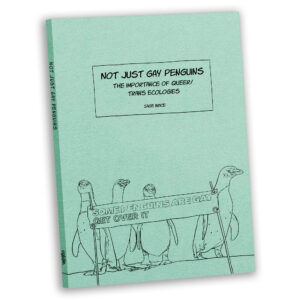
Not Just Gay Penguins: The Importance of Queer/Trans Ecologies
Graphic non-fiction, 48 pages, 175 x 249 mm
Black & White. Printed on 100gsm Munken smooth cream, with 210gsm Colorplan Park Green cover. Published by Cultural Geography (Un)limited (Bristol and Durham) and printed by Gomer (Wales). Nature may be queerer than you think - and we’re not just talking about gay penguins… This graphic non-fiction guide provides an entry point into thinking with queer/trans ecologies. Anyone curious about the relationships between gender, sexuality, race, reproduction, and human exceptionalism will find this a valuable resource and provocation. Queer/trans ecologies names a growing body of thought across the arts, humanities, and social sciences that goes beyond merely celebrating the existence of ‘queerness’ in nature. Instead, it aims to unravel those persistent circular logics through which nature and the natural are made to align with cisgender and heterosexual norms. Combining richly detailed drawings and visual storytelling with critically reflective prose, the book inspires a deeper interrogation of what so often goes unquestioned when considering ‘nature’ and the ‘social’.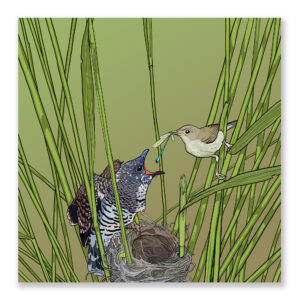
Cuckoo Chick
Eurasian cuckoos are one example of the myriad ways family structures in nature do not conform to the hetero-reproductive ideal of one man + one woman + progeny.
We tend to think and speak of cuckoo parents as either neglectful (the genetic parent) or victimised (the foster parent). It is easy to read tragedy into the situation of the tiny host parents working desperately to feed another’s offspring after their own eggs/chicks have been thrown from the nest. And host species do evolve defences to avoid being used in this way. But we do not know how the individual birds experience foster parenting. We do know they are following and fulfilling the parental instincts they would have followed with their own chicks. It is perfectly possible that they are fulfilled parents. The cuckoo chick may never meet its genetic parent, but there is no reason to assume it would wish to. Either way, this example is a reminder both that families come in all shapes and sizes, and that we can’t derive ethical arguments from nature: what is natural is not necessarily good, and what is good is not necessarily natural. What is unnatural is not necessarily bad, and what is bad is not necessarily unnatural.
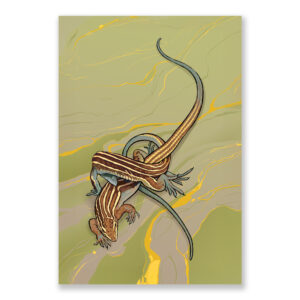
Whiptail Lizards
Desert grassland whiptail lizard (Aspidoscelis uniparens), an all-female species that reproduces asexually. The lizards engage in flirting and sexual play (referred to by cis-heteronormative science as courtship and pseudo-copulation) which appears to promote fertilisation. This species possesses chromosomal triplets, which enable the generation of a genetic diversity previously thought unique to sexually reproducing species, and thereby facilitate the long term survival of the species.
Thanks to Valentino Mauricio for the photo reference; DOI: 10.1016/j.yhbeh.2006.05.001